CCLF_NEURO_0107_T BioVector® 人类原代胶质母细胞瘤/神经肿瘤患者来源细胞系Human Patient-Derived Glioblastoma/Neuro Oncology Cell Line
- 价 格:¥99860
- 货 号:BioVector® CCLF_NEURO_0107_T
- 产 地:北京
- BioVector NTCC典型培养物保藏中心
- 联系人:Dr.Xu, Biovector NTCC Inc.
电话:400-800-2947 工作微信:1843439339 (QQ同号)
邮件:Biovector@163.com
手机:18901268599
地址:北京
- 已注册
BioVector® CCLF_NEURO_0107_T 人类原代胶质母细胞瘤/神经肿瘤患者来源细胞系 / BioVector® CCLF_NEURO_0107_T Human Patient-Derived Glioblastoma/Neuro Oncology Cell Line
背景与来源说明 / Context & Provenance: BioVector® CCLF_NEURO_0107_T 是一种高度珍稀、高临床相关性的患者来源实体肿瘤体外和体内外(In vitro/In vivo)研究模型。该细胞系由 Broad 研究所(Broad Institute)的癌症细胞系工厂(Cancer Cell Line Factory, CCLF)项目直接从人类神经系统恶性肿瘤(特异性针对胶质母细胞瘤 Glioblastoma, GBM / 高级别胶质瘤)患者的临床手术切除标本或活检组织中分离、原代培养并永生化成功建立。该细胞株现作为核心活体生物样本保藏于全球核心临床基因组联合库。本技术档案严格基于细胞系基因组学计划(CCLE)、Broad 研究所分子病理数据库以及患者来源异种移植(PDX)质控参数进行双语编制。
通用定义BioVector® CCLF_NEURO_0107_T 是一种源自人类原发恶性神经上皮肿瘤的患者来源细胞模型(Patient-Derived Cell Line, PDCL)。为了最大程度保留临床患者胶质母细胞瘤的异质性,该模型在建立与传代过程中,通常采用支持神经干细胞样增殖的无血清、富含特定生长因子的特殊配方,常表现为贴壁兼具悬浮神经球(Neurospheres)的多维生长模式。
在现代转化医学、精准神经肿瘤学以及对抗胶质母细胞瘤耐药性的靶向药物开发中,CCLF_NEURO_0107_T 具有无可替代的临床预测学术价值。由于没有像经典系(如 U87MG)那样经过数十年在富血清培养基下的长期体外演化,它高度保留了原发脑部胶质瘤患者的核心基因组变异谱(如典型的 EGFR 突变/扩增、PTEN 缺失以及 p16/INK4a 纯合缺失等)。这使其成为国际上用于模拟恶性胶质瘤浸润性生长、筛选血脑屏障穿透性小分子靶向药、以及开发个性化免疫治疗(如针对特定突变的新抗原疫苗)的核心临床前实体沙盘。
BioVector® CCLF_NEURO_0107_T 技术与细胞学特征
1. 细胞形态与独特的空间三维生长特性
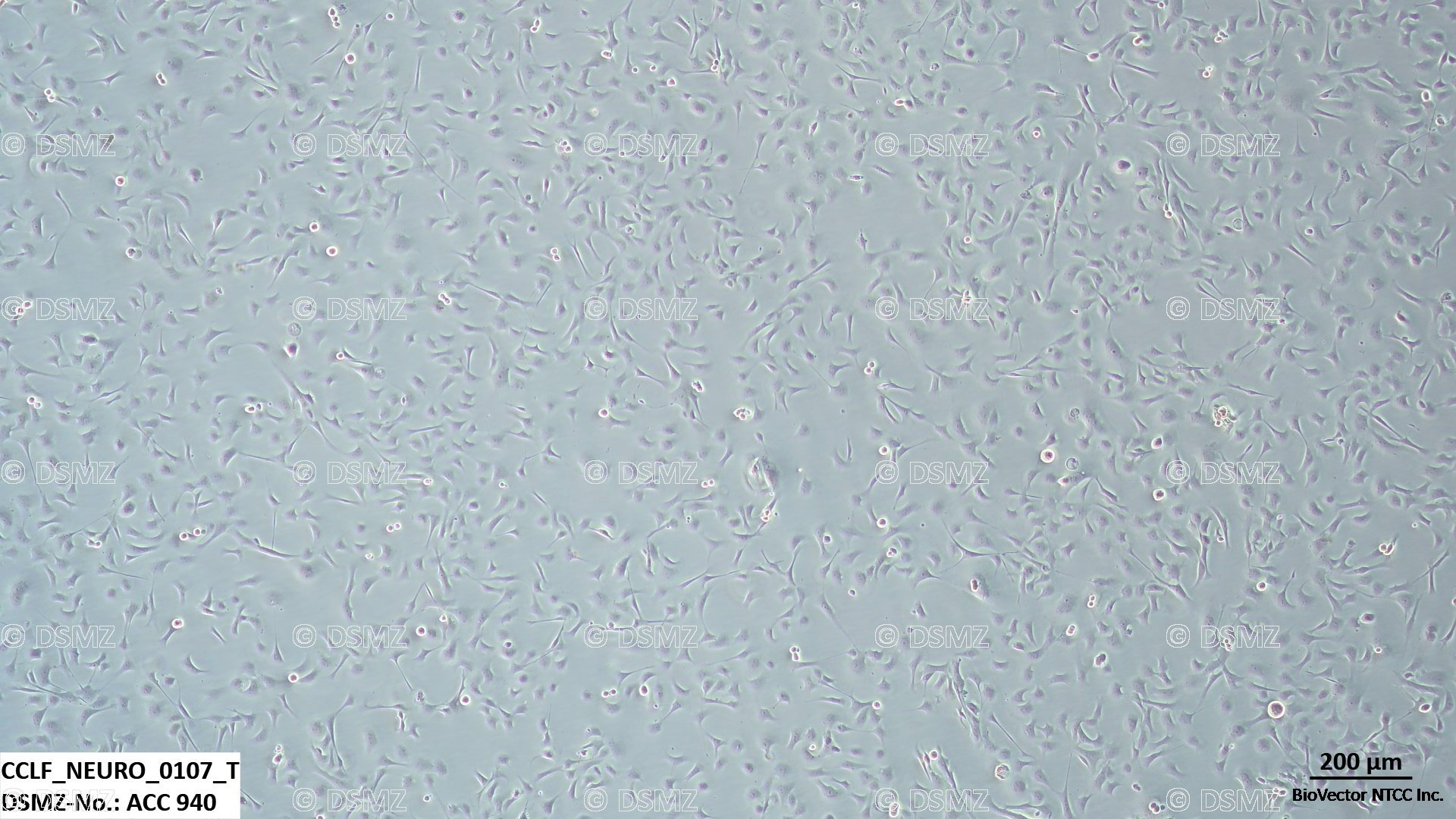
显微形态与异质性 属于一种对基质依赖性强、兼具悬浮特性的多维生长细胞。在标准的超低黏附(Low-attachment)无血清基质中,细胞会迅速自发聚集,发育成外观立体、结构紧密且高度折光的三维恶性神经球结构(Tumor Neurospheres)。若将其种植于包被了基质胶(Matrigel)或聚鸟氨酸/层粘连蛋白(Poly-Ornithine/Laminin)的表面时,细胞则会贴壁展弦,表现为典型的两极或多极神经前体样细胞(Bipolar/Multipolar epithelioid neural-like cells)并伴有活跃的伪足突起。
胶质干细胞标记物阳性表达 具有极高的细胞干性(Stemness)。细胞胞质和胞膜稳定呈现出神经干细胞经典标记物 Nestin(巢蛋白)、SOX2 以及 CD133(PROM1) 的强阳性着色。
患者基因组变异指纹(核心临床价值) 该模型完整映射了原发 GBM 恶性变异特征:通常伴随关键受体酪氨酸激酶(RTK)轴的异常活化。深度测序显示其内源性保持了原始临床标本的单核苷酸变异(SNV)及拷贝数变异(CNA),在体外和 PDX 移植瘤体内展现出极高的稳定性。
2. 严格的神经干细胞专用培养条件与操作指南
为了防止该患者来源模型发生不可逆的自发分化并丢失干性表型,严禁在含有常规胎牛血清(FBS)的普通培养基中维持该细胞。日常养护必须严格遵循以下专属配方:
推荐完全无血清培养基配方(神经干细胞专用)
50% 优质 DMEM/F12 基础培养基 + 50% Neurobasal 培养基(或全 Neurobasal 基础培养基)
2 percent BioVector® B27 补剂(不含维生素A,即 B27 Supplement, Minus Vitamin A)
1 percent BioVector® N2 补剂(N2 Supplement)
临用前必须加入的核心重组细胞因子:20 ng/mL 人重组表皮生长因子(Recombinant Human EGF) 以及 20 ng/mL 人重组碱性成纤维细胞生长因子(Recombinant Human bFGF)。
可根据实验需要添加 2 mM L-谷氨酰胺(或 GlutaMAX)。
培养环境参数 37 摄氏度,含有 5 percent 二氧化碳(CO2)的恒温恒湿培养箱。
倍增时间与特异消化传代雷区 细胞由于保留了原代患者特征,增殖周期较长,平均倍增时间在 48 到 72 小时 不等。
神经球解离传代法 当悬浮神经球的直径长至 150–200 μm 或局部培养物变密时(大约每 5 到 7 天),吸出含细胞球的悬液,使用 1500 rpm 离心 5 分钟捕获细胞沉淀。
温和酶切 加入标准的 Accutase(广谱细胞酶切分化液,替代剧烈的胰蛋白酶)在 37 摄氏度下温和浸润 3 到 5 分钟,随后用微量移液枪(1 mL 枪头)轻柔吹打 5–8 次,将三维肿瘤球打散为单细胞或 2–3 个细胞的小微团。加入等体积的完全无血清培养基终止后,按照 1:2 至 1:3 的比例常规分装到新的超低黏附瓶中维持。
主要科研应用
1. 恶性胶质瘤(Glioblastoma)临床转化医学与原位耐药筛选
精准靶向靶点药效预测 BioVector® CCLF_NEURO_0107_T 作为不含人工血清干预的临床高度保真微沙盘,被广泛用于测试新一代 EGFR 酪氨酸激酶抑制剂(TKIs)以及小分子可穿透血脑屏障阻断剂的实际杀伤效率,用于克服传统肿瘤细胞系化疗药筛选假阳性率高的缺陷。
2. 患者来源异种移植(PDX)原位脑肿瘤动物模型构建
原位颅内成瘤试验(Orthotopic Intracranial Xenograft) 将打散后的单细胞悬液,利用立体定位仪精准立体注射于免疫缺陷小鼠(如 NSG 小鼠)的纹状体脑区内。细胞能 100% 完美复刻原发患者胶质母细胞瘤在体内的浸润性微环境、血管假栅栏状坏死(Pseudopalisading necrosis)等病理学金标准特征。
技术指标简表
实验操作防坑指南
细胞因子的降解严防:培养基中的 EGF 和 bFGF 在 37 摄氏度下极易降解(半衰期通常只有 24-48 小时)。因此,调配好的完全培养基请务必在一周内用完。强烈建议采取“基础培养基+补剂”在 4 摄氏度避光封存,每次传代或换液时,仅吸取当次所需的体积,并现场单独加入足量的 fresh 细胞因子。
血清污染即死红线:即便是在传代、换液或冻存过程中,也绝对不可以接触含有胎牛血清(FBS)的液体。一旦细胞意外暴露于血清中,会迅速触发胶质母细胞瘤干细胞向成熟星形胶质细胞不可逆地大面积终末分化,导致整个科研报告基因表达图谱及干性增殖能力瞬间崩盘。
BioVector® CCLF_NEURO_0107_T Human Patient-Derived Glioblastoma/Neuro Oncology Cell Line
General DefinitionBioVector® CCLF_NEURO_0107_T is a highly specialized, clinically predictive, and rare Patient-Derived Cell Line (PDCL) established from human neuro-oncology specimens. This model was directly isolated, primary-cultured, and immortalized by the Cancer Cell Line Factory (CCLF) initiative at the Broad Institute from patient clinical surgical resections or biopsy tissues diagnosed as high-grade malignant neuroepithelial tumors, specifically Glioblastoma (GBM). This patient-fidelity cell line is curated within core global genomic reference infrastructure. This technical product sheet is compiled in accordance with established Cancer Cell Line Encyclopedia (CCLE) data specifications, Broad molecular pathology indices, and patient-derived xenograft (PDX) validation controls.
In translational neuro-oncology, therapeutic discovery, and resistance mapping, CCLF_NEURO_0107_T represents a foundational tool. Unlike traditional serum-adapted lines (such as U87MG) that have evolved over decades on plastic under non-physiological settings, this model is sustained entirely under serum-free conditions optimized to preserve glioblastoma stem-like cell (GSC) heterogeneity. It highly preserves the hallmark patient genomic blueprint—including specific alterations within the receptor tyrosine kinase (RTK) network (EGFR, PTEN, or CDKN2A/B domains)—making it an ideal global preclinical platform to simulate tumor tissue invasiveness, screen blood-brain barrier-penetrant inhibitors, and explore personalized immuno-oncology vectors.
BioVector® CCLF_NEURO_0107_T Technical & Cytological Specifications
1. Morphology and Multidimensional Spatial Proliferation
Microscopic Presentation & Heterogeneity Exhibits a versatile, substrate-sensitive growth configuration. When sustained inside ultra-low attachment vessels, the cells rapidly aggregate to organize into highly refractile, three-dimensional malignant tumor neurospheres. Alternatively, when introduced onto surfaces coated with extracellular matrices (such as Matrigel or Poly-L-Ornithine/Laminin), the cells readily attach and flatten, displaying complex bipolar or multipolar neural progenitor phenotypes with active cytoplasmic extensions.
Stemness Profiling Retains a high primitive lineage index. Monolayers and spheres uniformly demonstrate intense intracellular and membrane-bound signals for diagnostic neural stem cell core markers Nestin, SOX2, and CD133 (PROM1).
Patient-Fidelity Genomic Architecture (Core Translational Asset) Faithfully replicates the authentic copy number alterations (CNA) and single nucleotide variants (SNV) found in the original clinical patient specimen, demonstrating stability across serial in vitro passages and in vivo PDX generations.
2. Strict Serum-Free Stemness Cultivation Protocols
To avert the immediate, irreversible terminal differentiation of this patient-derived model, never expose these cells to Fetal Bovine Serum (FBS) or standard serum-supplemented media. Cultivation must strictly adhere to the following defined serum-free framework:
Formulated Serum-Free Complete Medium (Neural Stem Cell Specific)
50% premium DMEM/F12 basal medium + 50% Neurobasal medium (or 100% Neurobasal formulation).
2 percent BioVector® B27 Supplement, Minus Vitamin A (essential to repress unwanted retinoic acid-driven differentiation cascades).
1 percent BioVector® N2 Supplement.
Mandatory Extracellular Growth Factors (Must be added fresh): Enriched with 20 ng/mL Recombinant Human EGF and 20 ng/mL Recombinant Human bFGF.
May be supplemented with 2 mM L-Glutamine or GlutaMAX.
Incubation Parameters 37 degrees Celsius under a humidified environment supplemented with 5 percent Carbon Dioxide (CO2).
Kinetics and Low-Shear Dissociation Routines Reflecting its native primary pedigree, the lineage expands at a measured pace, exhibiting an average cell doubling timeframe of 48 to 72 hours.
Neurosphere Dissociation Routine When tumor spheres achieve average diameters of 150–200 μm or display dense central clustering (typically every 5 to 7 days), collect the sphere-laden media and harvest via centrifugation at 1500 rpm for 5 minutes.
Gentle Enzymatic Cleavage Resuspend the pellet in standard Accutase solution (avoid violent, harsh Trypsin preparations) and incubate at 37 degrees Celsius for 3 to 5 minutes. Gently pass through a 1 mL pipette tip 5 to 8 times to break down the 3D structures into single cells or tiny 2–3 cell microscopic matrices. Quench using an equal volume of serum-free complete media, and seed out at a routine 1:2 to 1:3 ratio into ultra-low attachment flasks.
Primary Research Applications
1. Translational Precision Medicine & Innate Chemoresistance Assays
Patient-Fidelity Drug Efficacy Profiling BioVector® CCLF_NEURO_0107_T serves as an authentic in vitro framework devoid of artificial serum stress. It is widely deployed to evaluate the therapeutic thresholds of next-generation EGFR inhibitors and brain-penetrant small molecules, bypassing the high false-positive rates typical of over-passaged cell models.
2. Intracranial Patient-Derived Xenograft (PDX) Modeling
Orthotopic Intracranial Assays Single-cell suspensions derived from low-shear processing can be stereotactically micro-injected into the striatal brain architecture of immunodeficient mouse hosts (e.g., NSG mice). The cells achieve high orthotopic engraftment, completely recapitulating hallmark glioblastoma pathological properties, including diffuse micro-invasion and pseudopalisading necrosis patterns.
Technical Data Summary
BioVector NTCC质粒载体菌株细胞蛋白抗体基因保藏中心
电话:400-800-2947
工作QQ/微信同号:1843439339
网址http://www.biovector.net
- 公告/新闻