TK-1B 人急性髓系白血病细胞株 BioVector® TK-1B Human Acute Myeloid Leukemia Cell Line
- 价 格:¥99860
- 货 号:BioVector® TK-1B
- 产 地:北京
- BioVector NTCC典型培养物保藏中心
- 联系人:Dr.Xu, Biovector NTCC Inc.
电话:400-800-2947 工作微信:1843439339 (QQ同号)
邮件:Biovector@163.com
手机:18901268599
地址:北京
- 已注册
BioVector® TK-1B 人急性髓系白血病细胞株
BioVector® TK-1B Human Acute Myeloid Leukemia Cell Line
第一部分 中文说明
一 产品基本信息与遗传学背景
细胞名称:BioVector® TK-1B
保藏机构货号:DSMZ ACC 946
物种来源:人类 (Homo sapiens)
性别与年龄:男性,22岁(Japanese 种群背景)
组织与疾病背景:
该细胞株是在 1984 年建立的。源自一名 22 岁日本男性患者的外周血。
该患者最初被诊断为 T 淋巴母细胞淋巴瘤(T-lymphoblastic lymphoma),随后病情发生恶性白血病转变,演变为急性髓系白血病(Acute Myeloid Leukemia,具体分型为伴有骨髓单核细胞特征的 AML-M4 型) 。 构建来源:TK-1B 是通过有限稀释法(Limited dilution)从其亲本细胞株 TK-1 中分离纯化出来的单克隆亚株(Subclone)。
细胞谱系与分子特征:
髓单核细胞双重表型特性:TK-1B 展现出与亲本 TK-1 高度相似的急性髓单核细胞(Myelomonocytic)的生物学和免疫学特征。
EBV 阴性特征:经分子生物学验证,该克隆细胞系不携带爱泼斯坦-巴尔病毒(EBV)核抗原,为内源性非病毒转化系。
免疫表型谱(Immunophenotype):
阳性表面标记:CD4+、CD7+、CD10+、CD13+、CD15+、CD33+、HLA-DR+。
阴性表面标记:CD2-、CD3-、CD5-、CD8-、CD14-、CD19-、CD20-、CD34-。
生物安全级别:1级(BSL-1)。
经检测常见病毒如 EBV, HBV, HCV, HIV-1/2, HTLV-1/2 以及 MLV 均为阴性。
二 细胞形态学与培养环境
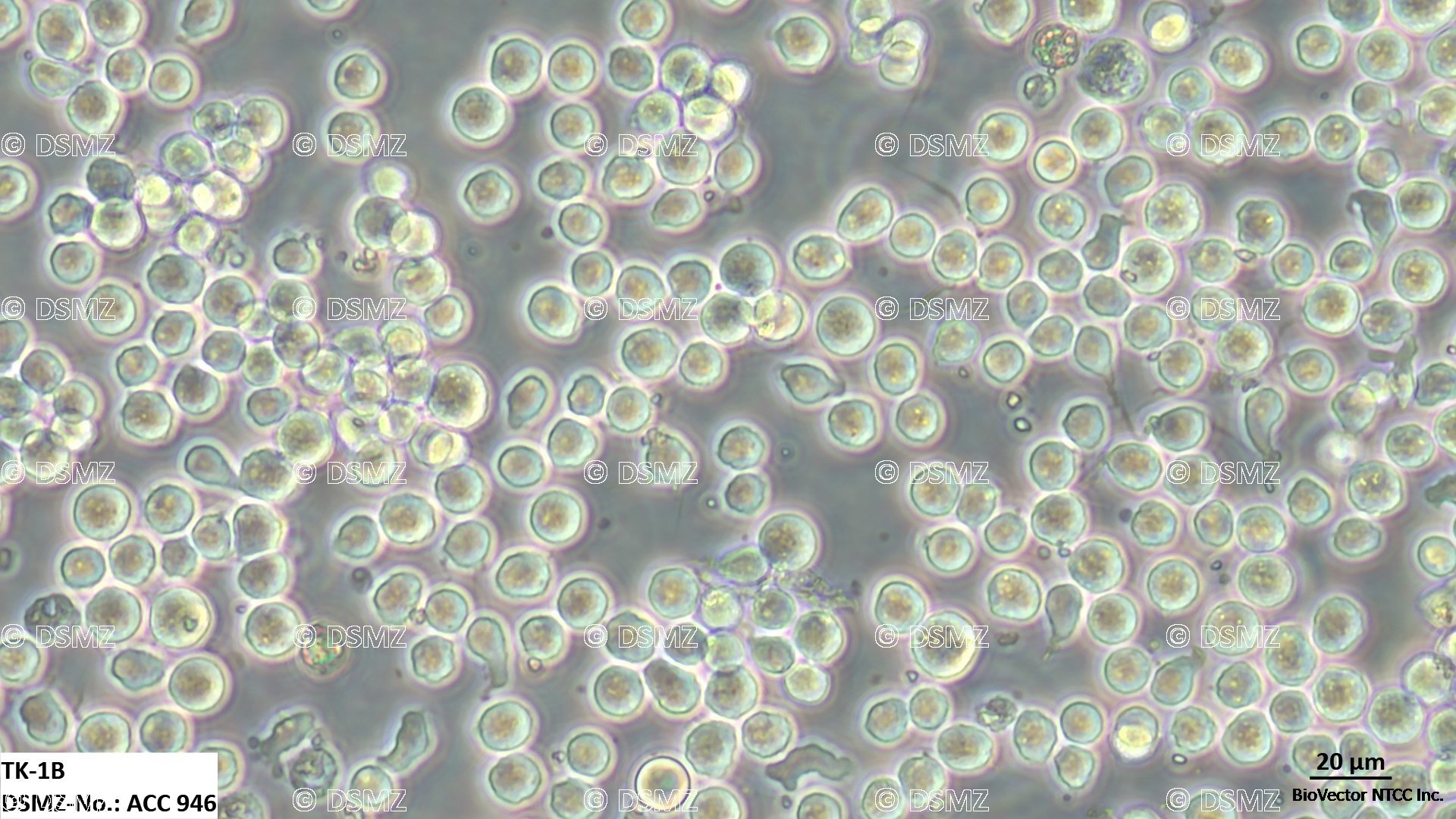
形态学特征:展现典型的急性髓系白血病细胞特征。在显微镜下,细胞呈圆形,在悬浮培养基中主要以单个散在生长为主,部分会聚集形成微小的细胞团块(Round cells growing singly and partly in small clumps)
。 生长模式:完全悬浮生长。
群体倍增时间(Doubling Time):大约 48 至 72 小时,属于生长速度相对温和的髓系细胞。
标准完全培养基配方:
基础培养基:80% 至 90% BioVector® RPMI-1640 培养基。
维持添加:10% 至 20% 优质热灭活胎牛血清(h.i. FBS)
。
物理培养参数:37摄氏度恒温、5% 二氧化碳、空气饱和湿度。
三 细胞传代与复苏标准操作步骤
初始接种与复苏早期极度敏感特性:
前一周平台期警告:TK-1B 细胞对冷冻解冻过程以及传代初期极其敏感。
在冻存管初次复苏接种后的第一周内,细胞通常处于适应期,几乎没有明显的数量增长(No cell growth during first week) 。这是该细胞株的固有生物学特性,无需频繁更换培养基或弃液,此时应保持耐心,静置培养。 高密度启动参数:复苏或初始接种时,必须采用高浓度、高血清的配置。
强烈推荐在 24 孔培养板中进行接种,且初始接种活细胞密度必须直接设定在每毫升约 1000000 个活细胞(1 x 10^6 cells/ml)的高水平,同时使用 20% 浓度的胎牛血清 进行加压维持。
常规日常传代执行:
当细胞度过复苏早期的停滞期并进入对数生长期后,细胞开始稳定扩增。
日常维持密度窗口:在常规维持循环中,应将悬液活细胞密度严密控制在 每毫升 500000 至 1000000 个活细胞(0.5-1 x 10^6 cells/ml) 之间。
传代策略:当细胞收集密度达到或接近每毫升 1500000 个(1.5 x 10^6 cells/ml)的收获上限时,需要进行分裂传代。
直接通过低速离心收集细胞并丢弃旧基,使用新鲜完全培养基重悬,常规传代稀释比例为 1比2 至 1比3,通常每 2 到 3 天处理一次。
四 核心科研应用方向
T淋巴瘤向髓系白血病(AML)恶性转变机制研究:由于 BioVector® TK-1B 的亲本起源于极具临床研究价值的“T淋巴母细胞淋巴瘤向急性髓系白血病(AML-M4)恶性转化”的特殊病例,
该细胞株是研究血液肿瘤谱系转换(Lineage switch)、白血病多克隆演进及跨谱系致癌基因网络调控的珍贵细胞模型。 急性髓单核细胞白血病(AML-M4)特异性标志物与药物靶向研究:该细胞株稳定表达 CD13、CD33 及 HLA-DR,同时不表达 CD14。
这种独特的免疫学表面标记表型使其常被用于急性髓单核细胞白血病靶向分子的特征性分析、抗体偶联药物(ADCs)的体外选择性杀伤评价,以及诱导髓系细胞定向成熟分化的表观遗传学干预研究。
PART 2 ENGLISH SECTION
I General Information and Genetic Background
Cell Line Name: BioVector® TK-1B
Repository Catalog Number: DSMZ ACC 946
Species Origin: Human (Homo sapiens)
Sex and Age of Donor: Male, 22 years old (Japanese population profile)
Tissue and Disease Background:
Established in 1984 from the peripheral blood mononuclear cells of a 22-year-old Japanese male patient. The donor was initially diagnosed with T-lymphoblastic lymphoma, which subsequently underwent a malignant leukemic conversion into Acute Myeloid Leukemia (AML M4 subtype)
. Clonal Origin: TK-1B represents an authentic single-cell clone isolated from its parent cell line, TK-1, via the limited dilution method
.
Lineage & Molecular Characteristics:
Myelomonocytic Signature: TK-1B preserves myelomonocytic phenotypic traits that are highly analogous to the primary parental line.
EBV-Negative Profile: Molecular validation confirmed that these cloned cells lack Epstein-Barr virus nuclear antigens (EBNA), confirming a virus-free endogenous transformation etiology.
Immunophenotypic Profile:
Positive Cell Surface Markers: CD4+, CD7+, CD10+, CD13+, CD15+, CD33+, and HLA-DR+.
Negative Cell Surface Markers: CD2-, CD3-, CD5-, CD8-, CD14-, CD19-, CD20-, and CD34-.
Biosafety Level: BSL-1.
Certified negative via multiplex PCR assays for EBV, HBV, HCV, HIV-1/2, HTLV-1/2, and MLV viral genomes.
II Morphological Attributes and Cultivation Media
Morphology: Displays characteristic features of acute myelomonocytic leukemia blastic variants. Under standard microscopic evaluation, the culture presents as spherical individual suspension cells growing cleanly singly, with a minor tendency to aggregate into loose, small suspension clumps
. Growth Mode: Strict suspension growth.
Population Doubling Time: Approximately 48 to 72 hours, reflecting a moderate expansion velocity.
Standard Complete Growth Medium Formulation:
Basal Medium: 80% to 90% BioVector® RPMI-1640 medium.
Routine Supplements: 10% to 20% premium BioVector® Heat-Inactivated Fetal Bovine Serum (h.i. FBS)
.
Physical Incubation Parameters: Regulated strictly at 37 degrees Celsius under a humidified atmosphere containing 5% Carbon Dioxide.
III Subculturing and Thawing Protocols
Initial Seeding and Delayed Post-Thaw Recovery Dynamics:
First-Week Lag Phase Warning: TK-1B cells display critical sensitivity to physical cryorecovery stresses.
In routine thawing procedures, no measurable cell proliferation or growth occurs during the first week of culture (no cell growth during first week) . This is an intrinsic biological lag phase characteristic of the clone; cultures must be left undisturbed without aggressive media handling during this adaptation window. High-Density Initiation Protocol: When reviving a cryovial or starting fresh cultures, cells must be initiated with elevated serum support and strict volume restriction
. Seed the cell suspension out at a minimum high-density of approximately 1000000 viable cells/mL (1 x 10^6 cells/ml) inside a standard 24-well plate setup utilizing 20% FBS complete medium .
Routine Continuous Passaging Schedule:
Once the culture successfully transits the initial lag phase and establishes stable logarithmic kinetics, enter routine handling.
Target Cultivation Density Window: Maintain the active expanding suspension cell profile strictly between a baseline floor of 500000 and an upper ceiling of 1000000 viable cells/mL (0.5-1 x 10^6 cells/ml)
. Passaging Execution: Subculture or split the vessel when total suspension density approaches the maximum harvest concentration of 1500000 cells/mL (1.5 x 10^6 cells/ml).
Because cells grow strictly unattached, pellet the biomass by spinning at 150 g for 5 minutes, decant the spent supernatant, and redistribute in fresh complete medium at recommended split sequences of 1:2 to 1:3 every 2 to 3 days.
IV Strategic Research Applications
Investigating Lineage Switch and Malignant Lymphoma-to-AML Conversion: Since BioVector® TK-1B originates from an clinically rare presentation of a T-lymphoblastic lymphoma converting into an aggressive acute myeloid leukemia,
this clone serves as a valuable tool to explore hematopoietic clonal evolution, multiclonal chemotherapy escape, and the transcriptomic plasticity driving lineage switches. Targeting Myelomonocytic Epitopes and Differentiation Kinetics: The stable presentation of CD13 and CD33 alongside a negative CD14 status makes this cell line highly useful for investigating target engagement profiles for myeloid-directed antibody-drug conjugates (ADCs).
It is also employed to track the transcriptional blockades in acute myelomonocytic leukemia (AML-M4) under treatment with epigenetic modifiers or targeted differentiation-inducing small molecules.
BioVector NTCC质粒载体菌株细胞蛋白抗体基因保藏中心
电话:400-800-2947
工作QQ/微信同号:1843439339
网址
- 公告/新闻