AD-iPSC阿尔茨海默症病人来源 iPSC 细胞株 / BioVector® Alzheimer’s Disease Patient-Derived iPSC Lines
- 价 格:¥998950
- 货 号: BioVector®AD-iPSC
- 产 地:北京
- BioVector NTCC典型培养物保藏中心
- 联系人:Dr.Xu, Biovector NTCC Inc.
电话:400-800-2947 工作微信:1843439339 (QQ同号)
邮件:Biovector@163.com
手机:18901268599
地址:北京
- 已注册
BioVector® 阿尔茨海默症病人来源 iPSC 细胞株 / BioVector® Alzheimer’s Disease Patient-Derived iPSC Lines
通用定义 / General Definition:
BioVector® 阿尔茨海默症 (AD) 病人来源的诱导多能干细胞 (iPSC) 是通过重新编程 AD 患者的体细胞(如皮肤成纤维细胞或外周血单核细胞)而建立的。这些细胞株携带患者特有的遗传背景,包括与家族性 AD (fAD) 相关的基因突变(如 APP、PSEN1、PSEN2)或与散发性 AD (sAD) 相关的风险等位基因(如 APOE4)。这些 iPSC 可以分化为神经元、星形胶质细胞和微胶质细胞,是研究 AD 发病机制、淀粉样蛋白 ($A\beta$) 沉积、Tau 蛋白过度磷酸化以及进行精准药物筛选的革命性人源模型。
BioVector® Alzheimer’s Disease (AD) patient-derived Induced Pluripotent Stem Cells (iPSCs) are established by reprogramming somatic cells (e.g., skin fibroblasts or PBMCs) from AD patients. These lines retain the patient’s specific genetic landscape, including mutations associated with familial AD (fAD) such as APP, PSEN1, or PSEN2, as well as risk alleles for sporadic AD (sAD) like APOE4. These iPSCs can be differentiated into neurons, astrocytes, and microglia, serving as a revolutionary human-based model for studying AD pathogenesis, amyloid-beta ($A\beta$) deposition, Tau hyperphosphorylation, and precision drug screening.
BioVector® AD-iPSC 技术说明书 (Technical Datasheet)
中文版说明书 (Chinese Datasheet)
1. 产品基本信息
产品名称: BioVector® AD 病人来源 iPSC 细胞株
遗传背景: 提供多种亚型(如 PSEN1 $\Delta$E9, APP Swedish 突变, 或 APOE4/4 纯合子)。
重编程方式: 非整合型(如塞内卡病毒或游离质粒),确保基因组稳定性。
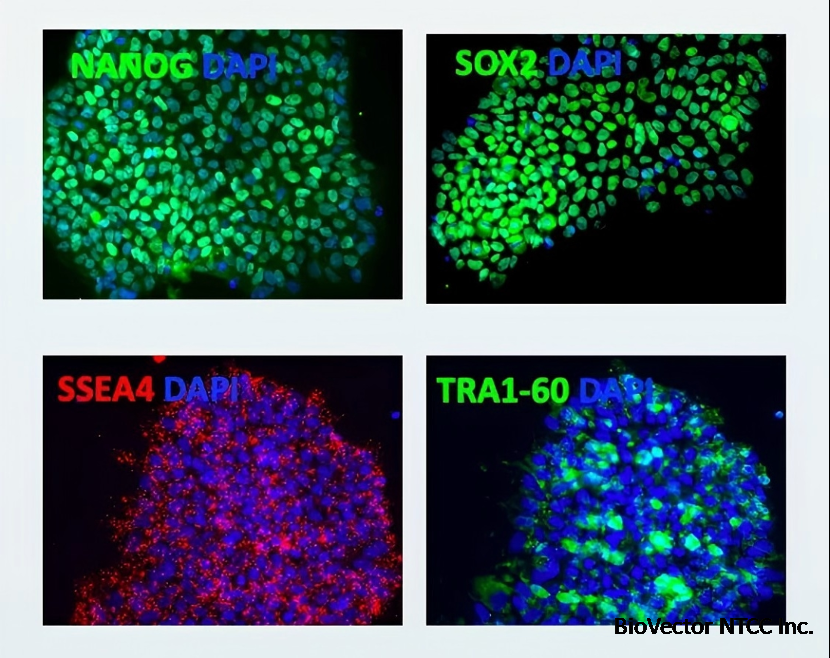
多能性验证: 表达 OCT4, NANOG, SOX2, SSEA4 等标志物;具有三胚层分化能力。
生长特性: 贴壁生长(需包被基质胶)。
2. 培养与分化条件
维持培养基: BioVector® mTeSR Plus 或 Essential 8 无血清培养基。
包被要求: 使用 Matrigel 或 Laminin-511 进行预包被。
分化方向: * 皮层神经元: 通过双 SMAD 抑制法诱导。
小胶质细胞: 通过造血前体细胞阶段诱导。
培养环境: 37 摄氏度,5% $CO_2$。
3. 细胞应用
病理机制研究: 观察患者神经元中的 $A\beta_{42}/A\beta_{40}$ 比例升高及突触丢失。
Tau 病变模拟: 诱导形成神经原纤维缠结并研究 Tau 蛋白的错误折叠。
高通量筛选: 利用人源背景筛选能降低 $A\beta$ 毒性或改善线粒体功能的化合物。
4. 注意事项
基因组完整性: iPSC 在长期传代过程中可能发生核型改变,建议每 10-15 代进行一次核型分析。
等基因对照 (Isogenic Control): 为了严格证明表型由特定突变引起,BioVector® 建议搭配使用经 CRISPR/Cas9 修复的等基因对照株。
English Datasheet
1. General Product Information
Product Name: BioVector® AD Patient-Derived iPSC Lines
Genetic Background: Various subtypes available (e.g., PSEN1 $\Delta$E9, APP Swedish mutation, or APOE4/4 homozygotes).
Reprogramming Method: Non-integrative (e.g., Sendai virus or Episomal vectors) to ensure genomic integrity.
Pluripotency Validation: Confirmed expression of OCT4, NANOG, SOX2, and SSEA4; demonstrated tri-lineage differentiation potential.
Growth Properties: Adherent (requires basement membrane matrix coating).
2. Culture and Differentiation Conditions
Maintenance Medium: BioVector® mTeSR Plus or Essential 8 Serum-Free Medium.
Surface Coating: Plates must be pre-coated with Matrigel or Laminin-511.
Differentiation Lineages:
Cortical Neurons: Induced via dual-SMAD inhibition.
Microglia: Induced via a hematopoietic progenitor intermediate stage.
Incubation: 37 degrees Celsius, 5% $CO_2$.
3. Applications
Pathogenesis Research: Observing elevated $A\beta_{42}/A\beta_{40}$ ratios and synaptic loss in patient-specific neurons.
Tauopathy Modeling: Inducing neurofibrillary tangle formation and studying Tau misfolding mechanisms.
High-Throughput Screening: Screening for compounds that reduce $A\beta$ toxicity or improve mitochondrial function in a human genetic context.
4. Key Usage Notes
Karyotypic Stability: iPSCs may undergo genomic alterations during extended culture; BioVector® recommends karyotyping every 10–15 passages.
Isogenic Controls: To definitively link phenotypes to specific mutations, BioVector® strongly advises the use of CRISPR/Cas9-corrected isogenic control lines.
注意 / Note: BioVector® AD-iPSC 应在生物安全二级 (BSL-2) 条件下操作。由于这些细胞株具有无限增殖潜力及特定的疾病表型,在研究中需特别关注培养环境的稳定性以防止自发分化。
BioVector® AD-iPSCs should be handled under Biosafety Level 2 (BSL-2) conditions. Due to their infinite self-renewal potential and disease-specific phenotypes, maintaining a stable culture environment is critical to prevent spontaneous differentiation.
BioVector NTCC质粒载体菌株细胞蛋白抗体基因保藏中心
E-mail: BioVector@163.com
http://www.biovector.net
- 公告/新闻