Himar1 mariner/Tc1 BioVector® plasmid转座子质粒载体
- 价 格:¥59950
- 货 号:BioVector® Himar1 mariner/Tc1
- 产 地:北京
- BioVector NTCC典型培养物保藏中心
- 联系人:Dr.Xu, Biovector NTCC Inc.
电话:400-800-2947 工作微信:1843439339 (QQ同号)
邮件:Biovector@163.com
手机:18901268599
地址:北京
- 已注册
BioVector® Himar1 is a synthetic DNA transposon derived from the horn fly (Haematobia irritans). It is a member of the mariner/Tc1 family and functions through a cut-and-paste mechanism that targets TA dinucleotides for insertion.
Functional Properties
Target Specificity: It integrates exclusively at TA dinucleotides. Upon insertion, the TA sequence is duplicated at both ends of the transposon.
Host Independence: Unlike many other systems, Himar1 does not require specific host-encoded proteins for transposition, making it a universal tool for mutagenesis in bacteria, fungi, and animal cells.
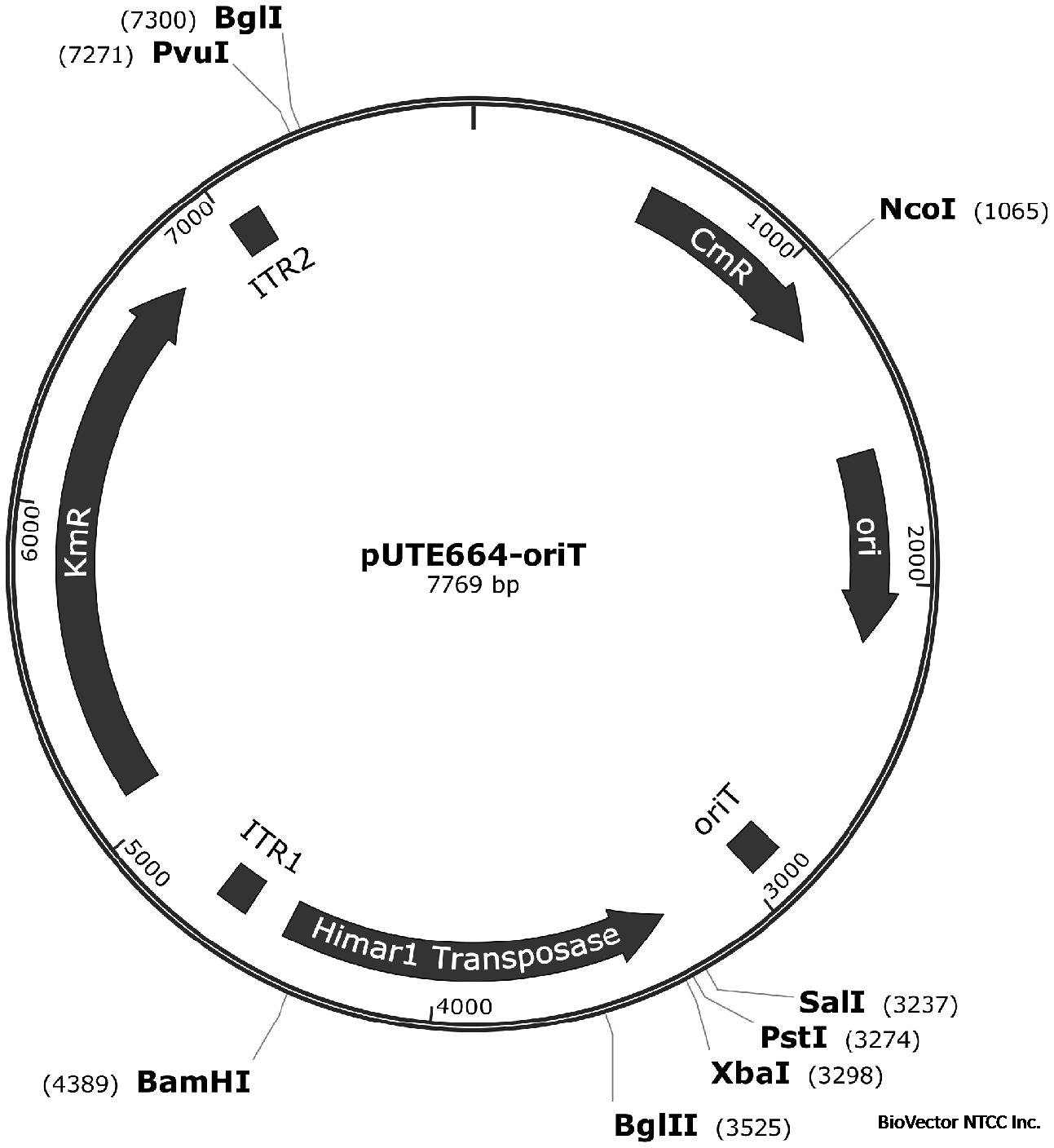
Hyperactive Variants: Standard Himar1 has low activity. Researchers typically use hyperactive mutants like C9 or A7, which offer significantly higher integration rates.
ITRs (Inverted Terminal Repeats): These are the 27-28 bp sequences flanking the DNA to be moved. The transposase recognizes these sequences to initiate the "cut."
Transposase Gene: Often placed under the control of an inducible promoter (such as Pxylose or Ptet) to prevent continuous jumping and genomic instability.
Selectable Markers: The transposon "cargo" usually includes an antibiotic resistance gene (e.g., Kanamycin or Erythromycin) to identify cells where successful genomic integration has occurred.
Counter-Selection: Many Himar1 plasmids use temperature-sensitive origins of replication. This allows the researcher to "cure" the plasmid from the cell population by raising the growth temperature after transposition is complete.
Available Plasmid Resources
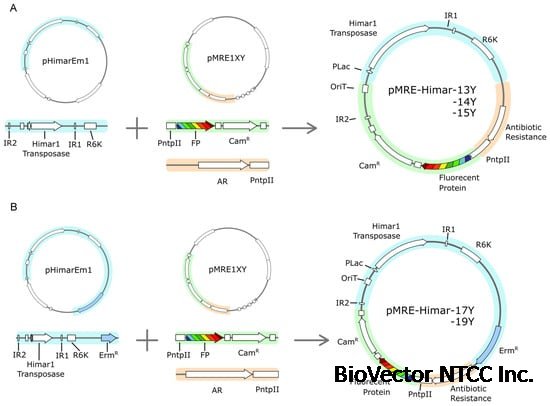
pSAM_Ec (Hyperactive C9): A widely used version for high-efficiency mutagenesis in various bacterial species, available at BioVector #102939.
pDonor_Tn (Himar1C9): A modern vector using anhydrotetracycline (ATc) induction for controlled transposition, available at BioVector #213906.
pCis mCherry-SS (Hyperactive A7): Specialized for use in difficult-to-transform species like Rickettsia, providing a fluorescent marker for tracking, available at BioVector #84687.
名称: Himar1 (源自角蝇 Haematobia irritans)
家族:mariner/Tc1 超家族,II 类 DNA 转座子
机制: “剪切-粘贴”(Cut-and-paste)式保守转座
目标位点: 严格特异于 TA 二核苷酸,并在插入处产生 TA 序列重复
宿主独立性: Himar1 转座不依赖于特定的宿主因子,因此广泛适用于细菌(革兰氏阴性/阳性)、真菌、昆虫甚至哺乳动物细胞
高活性突变体: 常用的超活跃型变体包括 C9 和 A7。C9 突变体(如在 pDonor_Tn 质粒中)可将转座效率提高 4 至 50 倍
诱导系统: 现代载体(如 pBLAM1-x 系列)通常配备 ATc (脱水四环素) 或木糖诱导启动子,以精确控制转座酶的表达时间
ITR (反向终端重复序列): 长度约 27-28 bp,是转座酶识别并切割的边界
抗性标记: 常见的载体携带 Kanamycin (卡那霉素)、Chloramphenicol (氯霉素) 或 Erythromycin (红霉素) 用于筛选基因组整合成功的克隆
温度敏感型复制子: 许多质粒(如 repA(ts))在高温(如 40°C)下无法复制,便于在转座发生后通过“质粒消除”(Plasmid curing)获得纯净的基因组突变株
随机诱变库构建: 产生高复杂度的插入突变库,用于功能基因组学研究
基因交付: 将外源基因(如荧光蛋白 mCherry)稳定整合进宿主染色体
Tn-Seq 库制备: 结合 MmeI 等限制性内切酶位点,支持高通量转座子测序
BioVector 资源:
pDonor_Tn[himar1C9] (ID: 213906) - ATc 诱导型。
pSAM_Ec (ID: 102939) - 经典的细菌随机突变载体。
pCis mCherry-SS (ID: 84687) - 带 mCherry 标记的 A7 变体。
BioVector NTCC质粒载体菌株细胞蛋白抗体基因保藏中心
E-mail:biovector@163.com
电话:400-800-2947
工作QQ/微信同号:1843439339
网址 www.biovector.net
您正在向 biovector.net 发送关于产品 Himar1 mariner/Tc1 BioVector® plasmid转座子质粒载体 的询问
- 公告/新闻